St. Francis of Assisi
Episcopal Church History
1986–1991
The beginnings of a mission
The earliest beginnings of St. Francis occurred in 1986 when the Diocese of East Tennessee, ECSET, and area parishes initiated discussion of church expansion. By 1987 the Mission Development Committee had narrowed its evaluation to the Ooltewah area. On June 21, 1988, 3.4 acres of land had been purchased on the corner of Providence Road and Ooltewah-Georgetown Road for a cost of $65,000.
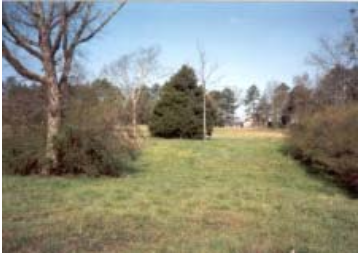
At the May 1991 meeting of the ECSET Board, Bishop Sanders announced that it was time to proceed with development of the new mission. The Bishop appointed a committee consisting of:
- The Rev. James F. Marquis, St. Martin’s
- The Rev. Louis E. Tonsmeire, St. Thaddeaus
- The Rev. Dr. James D. Curtis, Grace Church
- Mr. C. Ralph Ewing, St. Timothy’s
- Mr. Daniel Faulkner, St. Martin’s
- Dr. James S. Morris, Grace Church
This committee was charged with planning a meeting of persons who were interested in the formation of the new church. Episcopalians in the general area were contacted and invited to a meeting—if they were interested in joining the new mission or would support the effort through prayers or other means. Approximately sixty persons attended the September 8, 1991, meeting, at which Bishop Sanders and Bishop Tharp explained the need to offer the expansion for worship in this area. The Rev. Buckley Robbins, assistant rector of Grace, was introduced as the vicar of the new, yet unformed, mission.
Organization of the mission coincided with the transition of the Episcopate as Bishop Sanders planned to retire and Bishop Tharp prepared to assume the office of Bishop. Thus, St. Francis stands as the last mission of Bishop Sanders and the first mission of Bishop Tharp.
1991–1992
A gathering place. A name.
Seeking a meeting place for the mission, numerous locations were considered. Finally an ideal facility—the old James County Courthouse—was made available for lease through the efforts of a real estate firm owned by an Episcopalian and a New York Jewish attorney-owner who felt that Episcopalians were “good people”.
The vicar was asked to approve the property, but was reminded that he should carefully consider any thought of rejection since “priests were much easier to find than meeting places.”
An intense workday was held to prepare the facility for use as a church. It soon became apparent the congregation was a cooperative, congenial group who enjoyed working together.
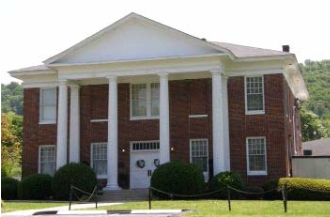
The first service was held November 3, All Saints Day, 1991, with fifty-one people in attendance. Since the mission had not yet received a charter, nor a name, it was referred to as the Ooltewah Episcopal Fellowship. While aware of the religious significance of the word “fellowship”, the members were not comfortable with the name. In January of 1992, Ruth Robinson of the Chattanooga Times quoted Betty Morris as saying, “We are anxious to get a name—We want to be Saint Something or other.”
When Bishop Tharp visited the Ooltewah Fellowship in January, he was greeted by a sign on the courthouse porch: “Welcome to St. Sumthenuruther.” At the meeting following the service, the Bishop was regaled with good humored appeals to allow a different name. Rejecting the name “St. Sumthenuruther” or “St. Elsewhere” the Bishop suggested the name Ooltewah Episcopal Church be acceptable until a permanent name could be chosen.
1992
Becoming St. Francis
The year 1992 saw many firsts:
- The first blessing of a marriage.
- The first funeral.
- The Mary-Martha Chapter of the Daughters of the King was organized.
- The first musical accompaniment and the parishioners joyously sang to the saxophone accompaniment of Wayne Evans.
- The first mission Council was elected.
The first celebration of the Great Vigil of Easter was celebrated on the church property. Bundled up and huddled under a tent, the first baptisms were performed with water from the spring on the property, a tradition which continues.
In preparation for the signing of the Mission Charter and application for mission status, a collection of silver was begun—old candlesticks, utensils and jewelry—all of which were used by Larry Epperson, Silversmith, to craft a chalice and paten. Mr. Epperson also hand carved a processional cross, which was a gift to the congregation from Bill and Marie Ray of Grace Church.
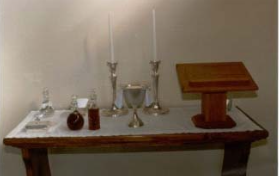
As Charter Day approached, the quest for a permanent name began and St. Francis of Assisi was the one selected. October 4 was chosen as Charter Day since it was the most suitable for all concerned. Only later, was it learned that unknowingly the date chosen was the Feast Day of St. Francis. Everyone was convinced that the Holy Spirit was at work in the selection of the name.
Charter Day was celebrated as the official recognition of St. Francis, Confirmation, dedication of the silver chalice and paten, with one hundred twenty people in attendance—exactly twice the number at the first meeting in 1991.
In December, the Mission was the recipient of a credence table, built and given by Gene Foster of Grace. Gene would later build as a gift, the altar to be used in the permanent building.
1992–1995
Building a permanent home
In December 1992, the decision was made to pursue the construction of the church building. Committees were appointed to formulate plans for architecture, construction, and financing.
At the 1993 Diocesan Convention, when St. Francis Church was presented, the delegation danced their way down the aisle to the sound of a saxophone playing “When the Saints Go Marching In” with their banner flying and hand bells ringing. This marked the formal approval of the church for mission status.
On February 28, the first Council of St. Francis of Assisi was elected. The members named were:
- Jim Morris, Senior Warden
- Gordon Moore, Junior Warden
- Betty Chadwick, Treasurer
- Bo Armstrong
- Bill Camp
- Ed McManus
- Betty Morris, Secretary
- Charlie Ann Curle
- Wayne Evans
- Jack Gross
- Katie Hall
- Betsy Healy
- Terry Power
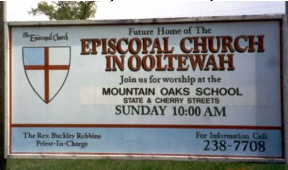
When the James County Courthouse was sold, a search for a meeting place once again began. Mountain Oaks Elementary School became the new temporary home on June 6, 1993.
St. Francis continued to grow as a Mission as the Episcopal Women of the Church was organized in June of 1993.
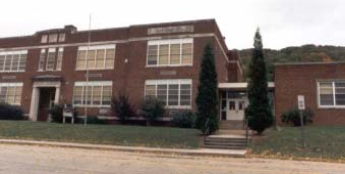
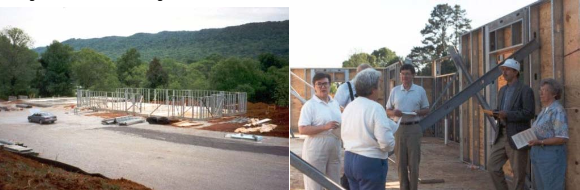
By fall of 1994, final plans for the building were completed and the contract for construction was awarded to J & J Contractors for $546,100. On December 4, Bishop Tharp and the vicar led the service of groundbreaking in the rain. Construction began on January 7, 1995, with a projected completion date of September 1, 1995.
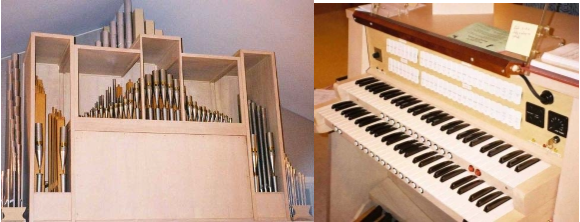
Bill Barger, an experienced musician and organ builder, helped to expand the music of the Mission, which had been previously provided primarily by Wayne Evans. Under Bill’s leadership, the church is able to increase its use of service music and hymns from the Episcopal Hymnal.
The dedication of the new church building took place on October 8, 1995.
1998–2003
Worship and remembrance
The Isa McIlwraith Plettner Memorial Moo Pipe Organ, a gift from Dr. Arthur R. Plettner, was dedicated on October 18, 1998. An annual recital is given each year for the community.
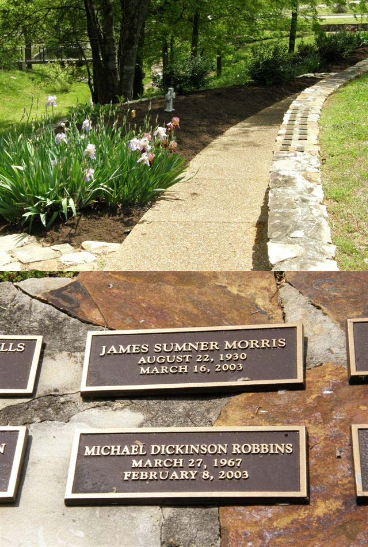
The dedication of Pilgrims’ Way on April 29, 2001, included a memorial garden, the Bishop Tharp Spring, a baptismal font, and a bridge. The Charlie Ann Curle library was dedicated on September 30, 2001.
St. Francis of Assisi was presented to the East Tennessee Diocesan Convention in Chattanooga on February 8, 2003, as a Parish.
2003–2007
A growing life together
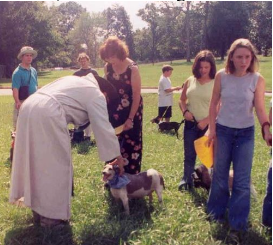
Our first St. Francis Day was celebrated with a decorated cake. The annual event has evolved into a celebration embracing the community with a parade, petting zoo, many more exhibits, and the Blessing of the Animals.
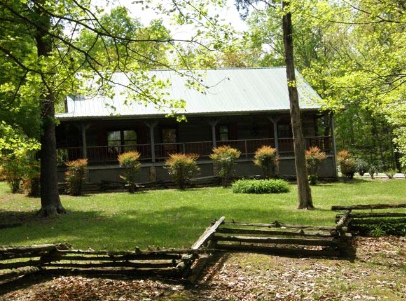
The log house on the hill behind the Church became available in the spring of 2003. The purchase not only gave the Church an additional place for meetings, small gatherings, and retreats, but increased our property by approximately 5.5 acres.
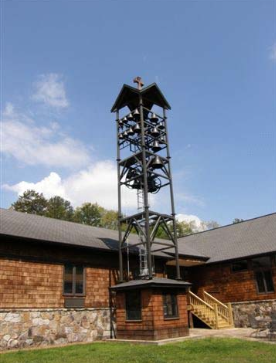
The Linnie M. Barger Memorial Chimes and tower were installed and dedicated in 2003. The bell tower was raised, and the instrument enlarged in the spring of 2007. Six additional bells were added, which was enough to qualify as a complete traditional carillon hand-played rather than electrified. We are the only Episcopal Church and the third church of any denomination in Tennessee to have such an instrument.
When The Right Reverend Robert Tharp spoke to the congregation on the Feast of St. Francis and the day of Charter signing in 1992, he said:
“He (St. Francis) gave up family wealth, his position as son and heir, he stripped himself before the community, and committed himself to God’s love and work alone. He looked for simplicity in life and in those who became his little flowers. You will know his story over and over again as you become the Franciscans of Ooltewah. The spirituality, the reaching out, and the acceptance of all persons will become part of your reason for being here as the Church of St. Francis of Assisi.”
It has so become.